There is no single Google Ads budget that works for every HVAC company. A sensible budget depends on the jobs you want, what each job contributes after direct costs, how many inquiries turn into paying customers, and how much work your team can handle. Start with a forecast for your service area and measure the cost of winning a job—not just the cost of a lead.
A low-cost call is not necessarily a profitable customer. An expensive installation inquiry may be valuable if it turns into a job with enough margin; a cheap inquiry may be a poor investment if it is outside your area or never books.
What do HVAC Google Ads leads cost?
The cost varies by location, service, competition, season, and what an advertiser counts as a lead. As one reference point, SearchLight’s January 2026 HVAC and plumbing benchmark reported an average of $104 per lead across the campaign types in its sample. Its non-branded search campaigns averaged $149 per lead. The report covers 816 contractors and $14.9 million in Google Ads spending in that month.
Those figures are observations from one provider’s dataset, not a quote or a forecast for your company. They combine HVAC and plumbing, reflect one winter month, and use the report’s own lead definitions. Your market, ad mix, customer response and tracking can produce very different results. The report also separates searches for a company by name from searches for a service; mixing them can make the cost of reaching new customers look lower than it is.
Start with the value of a completed job
Consider the revenue from a typical job and subtract the direct costs of delivering it, such as equipment, parts and technician labor. This gives a contribution before overhead and advertising. Decide how much of that amount the business can reasonably spend to win the job, leaving room for overhead, profit and other costs.
Repair, replacement, maintenance and commercial contracts can have very different economics. A maintenance visit may have modest immediate value but could lead to repeat work; include future value only when your records support it. A commercial installation may be worth more but take months and several proposals to close.
Turn the lead cost into a cost per paying job
Use actual figures whenever possible. Divide advertising spend by the number of paying jobs attributable to those ads over an appropriate period. This is your advertising cost per paying job. Add management fees and other relevant acquisition costs separately if you want a more complete view.
For example, suppose an HVAC company spends $3,000 on ads and records 30 inquiries. That is $100 per inquiry. If six become paying jobs, ad spend per paying job is $500. If average contribution after direct job costs is $800, the remaining $300 per job must still cover overhead, agency fees if applicable, other acquisition costs and profit. These numbers are illustrative, not a benchmark or a promise.
If you cannot link inquiries to paid work, the $100 lead figure alone cannot tell you whether the campaign is profitable. Keep the same definitions and time period when comparing results, and account for jobs that close later.
How to choose a starting budget
Work backward from the number of additional jobs your team can serve. Estimate how many inquiries you may need based on your own lead-to-customer rate, then consider a plausible cost per inquiry. Compare the estimate with local demand and the funds available for a meaningful test. If you have no reliable history, treat each assumption as uncertain and review it with your agency.
Using the earlier example, six additional jobs require about 30 inquiries if one in five inquiries becomes a paying job. At the assumed $100 per inquiry, the ad budget would be $3,000. Change those assumptions to match your own results; add setup or management fees separately and check that your team has capacity.
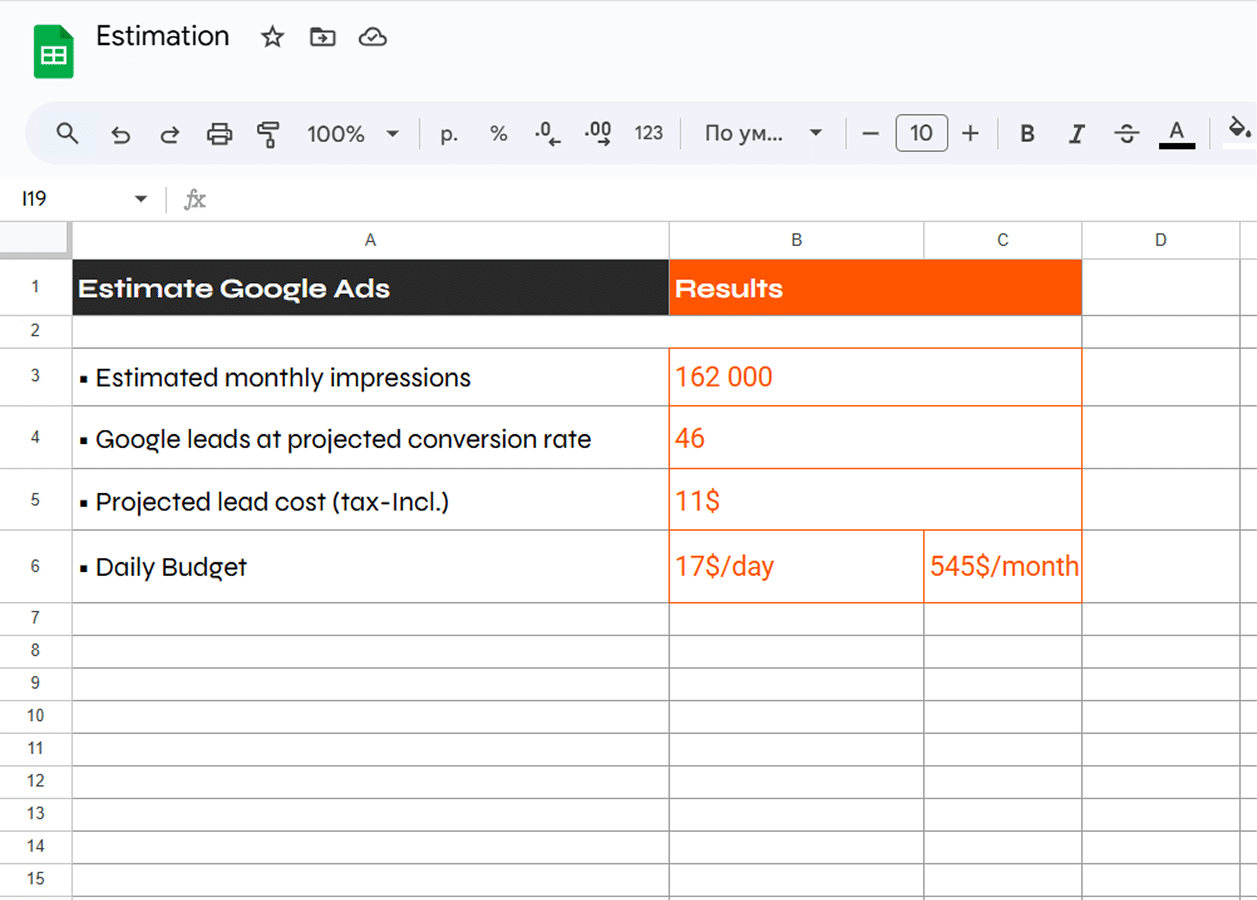
What could Google Ads cost for your HVAC business?
Industry averages provide context, but they cannot tell you what to expect in your service area. Before you commit to a budget, WEB ALTERNATIVE can prepare a free Google Ads forecast based on your services, location, and business goals.
The forecast can help you estimate local search demand, an advertising budget, potential inquiries, and the cost per inquiry. These figures are estimates, not guaranteed results. Actual performance depends on your market, campaign, website, and how your team handles inquiries.
Three HVAC situations, three budget decisions
A small team with open repair slots: Focus the initial forecast on the service area and jobs the team can handle. If calls go unanswered or technicians are already fully booked, increasing spend may create demand the business cannot serve.
A company looking for more replacement jobs: Compare the contribution from an installation with its acquisition cost and longer sales process. Track estimates and completed jobs, not just inquiries. A higher cost per lead can still make sense when enough inquiries become profitable installations.
A commercial HVAC contractor: Review whether inquiries come from organizations that fit your service and deal size. Some contracts need several proposals and take months to close, so early lead counts alone can be misleading. Track qualified opportunities and signed work over a period that reflects your sales cycle.
Consider season and capacity together
Demand for cooling and heating services can change with local weather. A company in Florida may have a very different pattern from one in Michigan. Look at your own call history, service area and crew availability before moving a budget. Paying for urgent calls when no technician can respond may create unhappy prospects rather than useful work.
A full schedule does not automatically mean all advertising should stop: maintenance plans and replacement estimates may serve different business goals from emergency repairs. Decide which jobs you can accept and how quickly you can respond before changing spend.
What an HVAC case shows about lead quality
In one WEB ALTERNATIVE HVAC case, a company supplying and servicing ventilation systems wanted business customers but was also receiving inquiries from private individuals who were not a fit. The team separated services in the campaigns, refined the audience and improved lead tracking. The case illustrates why the right type of inquiry matters. It concerns project-based B2B work; its results should not be treated as a forecast for residential HVAC contractors.
What to ask your Google Ads provider
A useful forecast or report should explain which services and locations it covers, the assumptions behind expected inquiries, the estimated ad spend and any separate fees. Ask what is counted as a lead, whether missed calls are included and how the provider will distinguish a booked appointment from a completed paying job.
Ask to see the assumptions behind a recommendation to increase spending. More budget may be appropriate when you can serve additional work and the economics support it; it will not by itself resolve missing tracking, unsuitable inquiries or unanswered calls. Our agency reporting checklist can help you frame that conversation.
Frequently asked questions
Can a small HVAC business start with a limited budget?
It can be possible, but the useful starting amount depends on local search demand, click costs, the jobs targeted and how much information the budget can generate. A local forecast can show whether your proposed spend is likely to provide enough data to make a decision.
Is a booked appointment the same as a paying customer?
No. A booked appointment may be canceled, produce no sale or lead to work later. Measure both appointments and completed paying jobs when possible, and define which advertising costs are included.
Should I use the same budget for repairs and replacements?
Not automatically. The urgency, revenue, direct costs and time to close can differ substantially. Compare the contribution and capacity of each service before deciding how much of the budget it deserves.
Does a low cost per lead mean Google Ads is profitable?
No. The inquiry must become enough profitable work to cover advertising, other acquisition costs and overhead. Low-cost inquiries that do not book or are outside your service area can still waste money.
Get a forecast for your HVAC business
Before committing to a budget, ask for estimates based on your services, location and goals. WEB ALTERNATIVE can prepare a free Google Ads forecast and discuss whether your planned spend fits your business. If campaigns are already running, request a free consultation to discuss the results and next steps.