A useful Google Ads budget for a small business is an amount that can buy enough relevant traffic to test your offer, while staying within what you can afford to spend on acquiring customers. There is no universal monthly amount: the right starting point depends on your market, location, services, margins, and ability to turn inquiries into sales.
Start with your business economics and an estimate of local demand. Then set a test budget and a review date with your advertising partner. Your ad spend and agency fees are separate expenses.
Start with the value of a customer
Before choosing a monthly number, estimate how much a new customer is worth after the direct costs of providing your product or service. Consider repeat purchases only when they are realistic for your business. This helps you set an acceptable acquisition cost instead of chasing the cheapest possible lead.
For example, suppose a completed job brings $1,000 in revenue and $600 remains after direct delivery costs. If you are willing to spend up to $200 to acquire that customer, your target leaves $400 before overhead and other costs. These numbers are illustrative, not a recommended margin or a guarantee.
If you close one in five qualified inquiries, a $200 customer acquisition target translates to about $40 per qualified inquiry. If your close rate or margin changes, the number changes too. Small samples can make this estimate unreliable.
Estimate the traffic needed to test your budget
Use a range for your expected cost per click and the percentage of visitors who become inquiries. For illustration, 200 clicks at $5 each would cost $1,000 in ad spend. If 5% of those visitors inquire, that would produce 10 inquiries at $100 each. These are assumptions to test, not expected results for your business.
Compare the estimated cost per qualified inquiry with your target. Not every inquiry will be a fit, and a form submission is not the same as a customer. If the expected range is far above your target, revisit the offer, service area, budget, or business economics before committing.
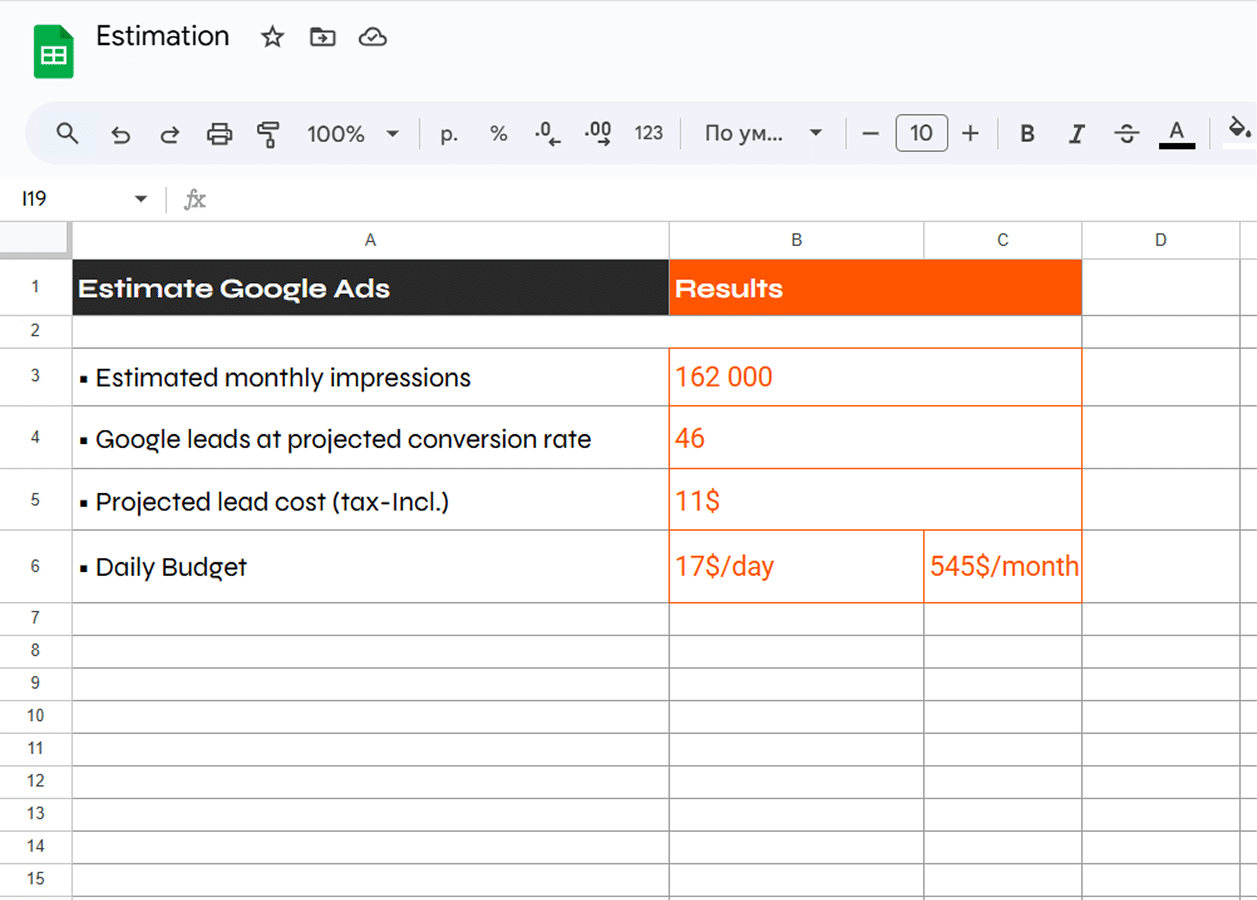
A Google Ads forecast can help estimate traffic, budget, and potential inquiries for your specific services and location. Treat it as a planning tool rather than a promise.
Account for more than the advertising bill
Ad spend: the amount paid to Google for advertising. Setup and management: fees for preparing and managing campaigns, if you hire an agency. Other work: landing page improvements, call handling, tracking, or CRM costs where needed. Confirm what is included before comparing proposals.
A low management fee does not automatically make a campaign affordable. Ask how the total investment relates to the number and value of customers you need. Our guide to Google Ads management costs explains the difference between service fees and ad spend.
What if your available budget is too small?
A limited budget can still be useful, but spreading it across many services and locations may make it harder to learn which opportunities work. Consider starting with a smaller set of valuable services and a practical service area. Ask your agency what demand may be missed and how much traffic the budget could reasonably buy.
If the proposed budget is unlikely to produce enough useful traffic for a meaningful assessment, postpone the launch, adjust the offer, or consider other channels. A smaller budget is not a guarantee of cheaper customers.
Decide how and when to review the test
Agree on what counts as a qualified inquiry, how calls and forms will be attributed, who follows up, and when you will review results. Include spend, inquiries, qualified opportunities, booked jobs or sales, and acquisition cost where data is available. Our agency reporting checklist can help you frame those questions.
Do not judge a campaign solely by a few days of clicks or a handful of leads. The useful review period depends on traffic, seasonality, and your sales cycle. If tracking is incomplete, say so before drawing conclusions or scaling.
Plan a budget for your own business
WEB ALTERNATIVE prepares a free Google Ads forecast tailored to your service and location, including estimated traffic, budget, leads, and cost per lead. A forecast is an estimate; actual results can differ.
Frequently asked questions
Is there a minimum Google Ads budget for a small business?
There is no single budget that fits every business. The amount needed for a useful test depends on click costs, demand, competition, and the results you need.
Does my Google Ads budget include agency fees?
Usually, ad spend and agency fees are separate. Ask for a written breakdown of setup, ongoing management, and any additional costs.
How much should I spend per day?
Translate your planned monthly ad spend into a daily starting figure and review Google’s billing rules with your manager. Actual daily spending can vary, so monitor the account and billing limits.
When should I increase my budget?
Consider increasing it when you can reliably track results, handle additional inquiries, and see a sustainable cost per customer. Check that the results are based on enough data and that additional demand exists.
Can a forecast guarantee leads or sales?
No. Forecasts use assumptions about demand, costs, and conversion rates. Actual outcomes depend on competition, your offer, your website, and follow-up.
Discuss your advertising plans
If you want to understand whether Google Ads fits your goals, request a consultation with WEB ALTERNATIVE.